
Criminal Court Cases in Cherokee County
Cherokee County Superior Court hears felonies. State Court handles misdemeanors and traffic matters, while Magistrate Court considers arrest and search-warrant applications, first appearances, preliminary issues, and bail. Municipal courts keep city ordinance and assigned traffic or misdemeanor files. Georgia has no universal lettered felony ladder. The offense statute and possible punishment control the classification.
The Clerk of Courts maintains Superior, State, and Magistrate filings at the Frank C. Mills III Justice Center. The District Attorney prosecutes felony cases in the Blue Ridge Judicial Circuit, and the Solicitor-General handles county misdemeanor prosecutions. Filed papers belong with the clerk; prosecutor-created records remain with the prosecutor.
The Cherokee County District Attorney page identifies the felony prosecution office and its programs.
That office is part of the case path, but the clerk remains custodian of the filed docket and judgment.
Cherokee County Court Jurisdiction
The named court helps decode the record. Superior Court has felony jurisdiction. State Court generally receives ordinary misdemeanors and traffic charges. Magistrate judges work around the clock for people booked into the Adult Detention Center, with three full-time judges on weekdays and seven part-time judges covering after-hours work. The county reports at least 30,000 Magistrate judicial activities each year, a count that includes more than criminal trials.
All principal courtrooms are at 90 North Street in Canton. Superior criminal calendars use courtrooms 2A through 2D, while State Court uses first-floor courtrooms. A booking charge can later be amended, reduced, dismissed, or replaced by the prosecutor's filed accusation or indictment. Use the filed charge and final judgment when describing what the court adjudicated.
Cherokee County Case Record Searches
The clerk currently links Tyler re:SearchGA for remote access. The provider may require an account, and automated access can encounter a barrier. The older Cherokee Icon interface exposed stable party and case concepts, but its warning remains important: the most complete and current record is held by the clerk. Search broadly before narrowing, since an omitted middle name or strict date range can hide a match.
- Open the clerk-linked provider and select the appropriate court or criminal case context.
- Search by party name, beginning with surname and first name, or enter the clerk-formatted case number.
- Compare court, filing date, case type, and judge so that similar names are not merged.
- Open the event history and distinguish allegations, filed charges, pleas, and disposition entries.
- Request the complete or certified document from the Clerk of Courts when the online view is incomplete.
| Search concept | Type | Required | Use |
|---|---|---|---|
| Last or business name | Text | Usually for party search | Begin with surname and avoid excess filters. |
| First name | Text | Optional | Narrows common surnames. |
| Middle name | Text | Optional | May exclude records without one. |
| Case number | Text | Alternative | Use the clerk's format when known. |
| Court or case type | Selector | Optional | Separates Superior, State, or Magistrate context. |
| Date range | Date fields | Optional | Narrows the filing or event period. |
The re:SearchGA source shows the current provider entry point.
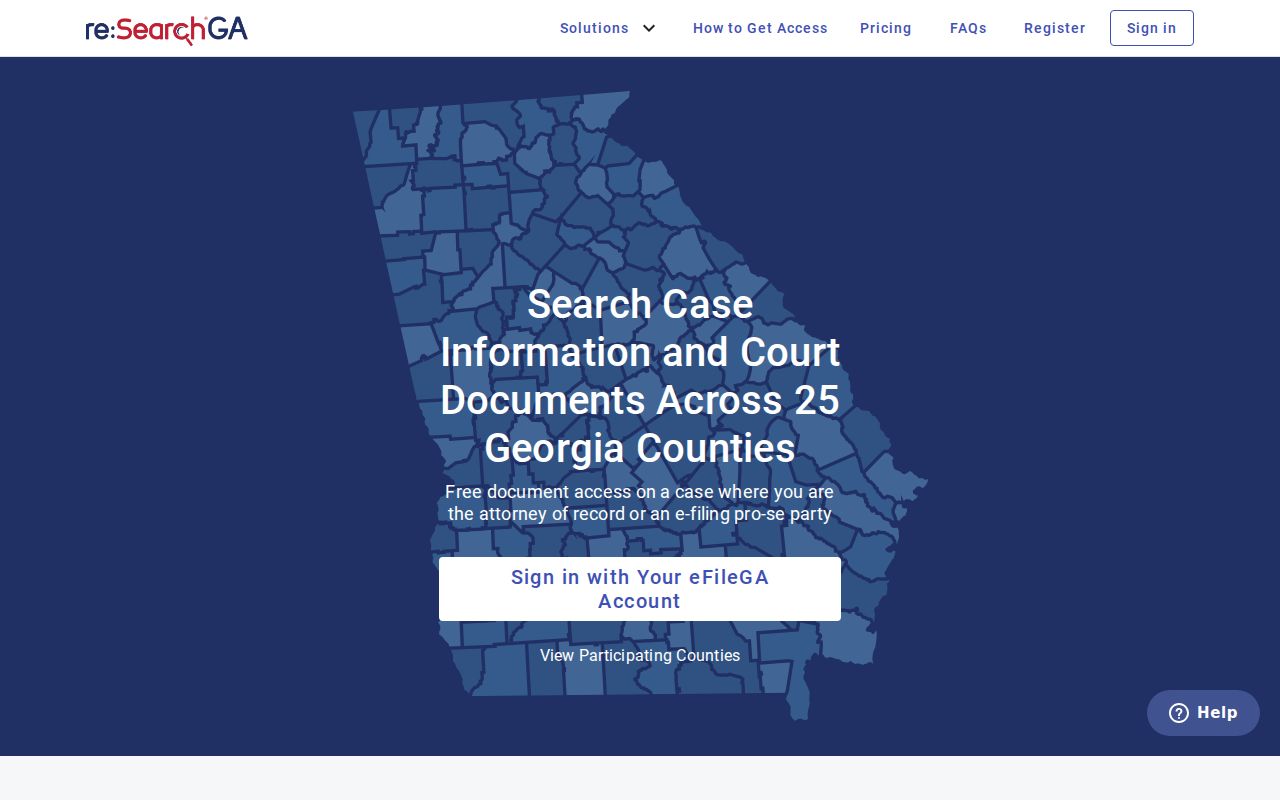
An account or access barrier does not end the search because the clerk counter and phone channel remain available.
Cherokee County Clerk File Controls
The complete retained file can be requested at Suite G-170, 90 North Street, Canton, Georgia 30114, Monday through Friday from 8:30 a.m. to 5 p.m. Call the State Court Clerk at 678-493-6511. The clerk can supply regular or certified copies under its procedures and statutory fees. Ask for a named item such as the accusation, indictment, plea, judgment, sentence, or certified disposition rather than an undefined “full record” when only one proof is needed.
The clerk's official copy procedures explain the available routes.
A portal print helps with research, but a certified copy bears the clerk's authentication and is the better choice when proof of outcome matters.
What a Criminal Case File Contains
A Cherokee County case file is organized around a case number and court. It can link the State, defendant, counsel, assigned judge, charges, docket events, judgment, and sentence. Public views may omit full dates of birth, Social Security numbers, protected victim details, juvenile information, or sealed documents. A document link may also be unavailable even when the docket entry remains visible.
| Case number and court | The unique file identifier and the Cherokee County court with jurisdiction. |
|---|---|
| Charging document | The accusation, indictment, complaint, or other filed statement of counts. |
| Docket entries | Filed papers and events such as arraignment, motions, pleas, calendars, and orders. |
| Hearing dates | Scheduled or completed court events, subject to later calendar changes. |
| Disposition and judgment | The legal result for each charge, which may differ from the arrest label. |
| Sentence and conditions | Confinement, probation, fines, restitution, or other court-ordered terms. |
“Disposed” alone does not reveal whether a count was dismissed, pleaded, tried, or otherwise resolved. Open the disposition or judgment.
Cherokee County Docket Terms Decoded
Docket language can conceal major differences. An arraignment is the stage where charges are formally presented and a plea is addressed. A nolle prosequi records the prosecutor's choice not to proceed; it is not the same as acquittal. A dead docket postpones prosecution indefinitely without deciding guilt. A bench warrant may follow failure to appear, but an online docket may not disclose an unserved or sealed warrant.
- Accusation
- A prosecutor-filed charging instrument often used for State Court misdemeanors.
- Indictment
- A grand jury charging instrument commonly used in felony cases.
- Disposition
- The result entered for a charge or case.
- FTA
- Failure to appear for a required court date, which can trigger further process.
When a code or short entry is unclear, ask the clerk for the underlying document rather than guessing from the abbreviation.
Criminal Case Stages in Cherokee County
A criminal file develops as separate offices act. Law enforcement first creates the report and booking materials. A prosecutor then decides what to file. The clerk records the charging instrument, hearings, motions, plea or trial events, judgment, and sentence. Courts and prosecutors later report disposition information to GCIC. Timing differs by case, so the docket should be read as an event history rather than a fixed schedule.
Case flow: Charges Filed › Arraignment › Pretrial › Plea or Trial › Disposition › Sentencing
A booking allegation may never become a filed count. Likewise, a filed count may be amended or dismissed. The final judgment and sentence state what the court actually decided.
Cherokee County Diversion Case Outcomes
The District Attorney's Pretrial Diversion Program gives eligible defendants a structured route outside ordinary adjudication. Current policy requires a timely application, discretionary approval, counsel at the plea stage, and compliance with conditions that can include restitution, service, screening, counseling, and fees. Sentencing is withheld after a guilty plea. Successful completion leads to dismissal and restriction, so the final docket matters more than the initial charge.
The official diversion program page provides the local eligibility and process details.
A dismissal after completion should be verified through the clerk and, where relevant, through the GCIC restriction result.
Cherokee County Accountability Court Files
Cherokee County operates Felony Drug Accountability, DUI, Treatment Accountability, and Veterans Courts. Drug Court began in 2013 and uses five phases with a minimum 18-month structure. Treatment Court began in 2016, and Veterans Court began in 2017. Participation can generate review hearings, program conditions, sanctions, progress entries, and a final outcome in the court file.
The county's accountability court overview describes these named programs.
Program participation does not erase the need to read the charging document and final order. Those papers show the court's legal action.
Access Rules for Case Records
Court files are generally available through the clerk, but public access has limits. Sealing orders, juvenile confidentiality, protected identifiers, victim-sensitive data, and court rules may remove or redact material. The Georgia Open Records Act is not a way around a judicial seal. It governs agency records, while court access follows the clerk's procedures and judicial rules.
Remote access may show less than the retained file. If a Cherokee County case does not appear, contact Suite G-170 with the name, approximate filing date, court, and case number if known. Ask whether the matter is in another court, archived, sealed, restricted from the provider, or indexed under a different name.
Georgia Courts supplies the statewide court-system context and official provider directory.
The local clerk is still the final source for Cherokee County authentication, copies, and questions about a missing docket.